Numerical modelling of circulating fluidized bed boilers

Modélisation numérique de lits fluidisés circulants

Résumé

Le but de cette coopération est la simulation numérique d’une chaudière à lit fluidisé circulant avec le code diphasique Estet-Astrid developpé par EDF. Les premiers travaux ont consisté à apporter quelques modifications au code afin d’améliorer son comportement dans le cas de lits denses et de réaliser une modélisation plus réaliste de la grille de fluidisation. Une étude paramétrique est prévue afin d’optimiser les ressources de calcul necessaires à la simulation tridimensionnelle de la maquette froide de la chaudière de l’université de Chalmers.

Description of the projet

Presentation :

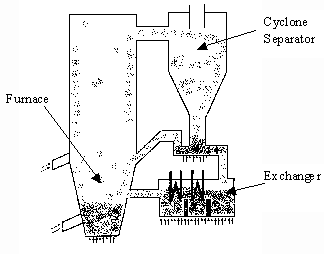
A circulating fluidized bed boiler is a reactor that allow chemical reactions or combustion of solid particles. It can operate with different kind of particles. The volumic fraction in that system can be very high and produce a dense bed. The mean fluid (air) velocity is lower than the particle free fall velocity but localy it can be greater so particles are transported outside the boiler. This is the reason why they are reintroduced in the furnace via the cyclone separator.

The circulating fluidized bed technology allows the combustion of poor quality coal with respect to the very strict pollution laws. The combustion is achieved inside the bed, particles are kept in suspension by a continuous air flow from the fluidization grid in the bottom part of the boiler. The air injection drag the particles to the upper part of the boiler where they are collected by the cyclone separator and later injected in the bed. Limestone and fresh particles are also introduced directly in the bed. The circulation enables a good combustion in spite of the low furnace temperature. This low temperqture is an essential condition for capture of polluting agents by limestones particles. An improved understanding of fluid dynamics in circulating fluidized bed is very important for the design of more powerfull and more efficent new boilers.

My project :

I am working in the Energy Conversion Department at Chalmers university. This department is supervised by professor Bo Leckner. The main studies are experimental works carried out on a 12 MW circulating fluidized bed boiler and on col rigs.
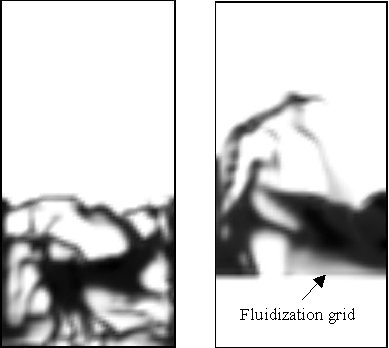
The goal of my work is to make numerical simulation of the cold rig fluidized bed using EDF two-phase fluid dynamics code : ESTET-ASTRID. This code has been already used to simulate that kind of boiler with low particles concentrations and results are in accordance with experimental results. But with a dense bed, simulations are much more difficult, so that my first task is to enable the code to simulate dense fluidized beds properly and to avoid numerical problems due to the high concentration of particles. After these improvements, I will have to add a pressure drop module in the code for the modelling of the air distributor. The two figures show the influence of the pressure drop across the grid on the flow. The left one shows the result of a two second simulation with an uniform gas velocity injection. The right one shows the same simulation with a wind box with no pressure. The fisrt case is equivalent to an infinite pressure drop across the fluidization grid. It as been shown experimentaly that the pressure profile on the grid is linked to the gas velocity and a relation has been given. After the implementation of the pressure drop in the code by adding a source term in the gas momentum equation, we will be able to make better simulations of bubbling regime in the boiler. Some tests and validations must be made on small two-dimensional cases. Previous calculations show that the mesh influence tremendously the simulations but calculation time is connected to mesh size. A parametric study is required in order to obtain a reasonnable ratio of mesh size to calculation time and a three-dimensional curvilinear mesh will be generated for the cold rig simulation. Results of that simulation will be discussed and compared to experimental data in order to validate the code or to find other way of improvement in the modelling.

Some fluid dymamics related links